
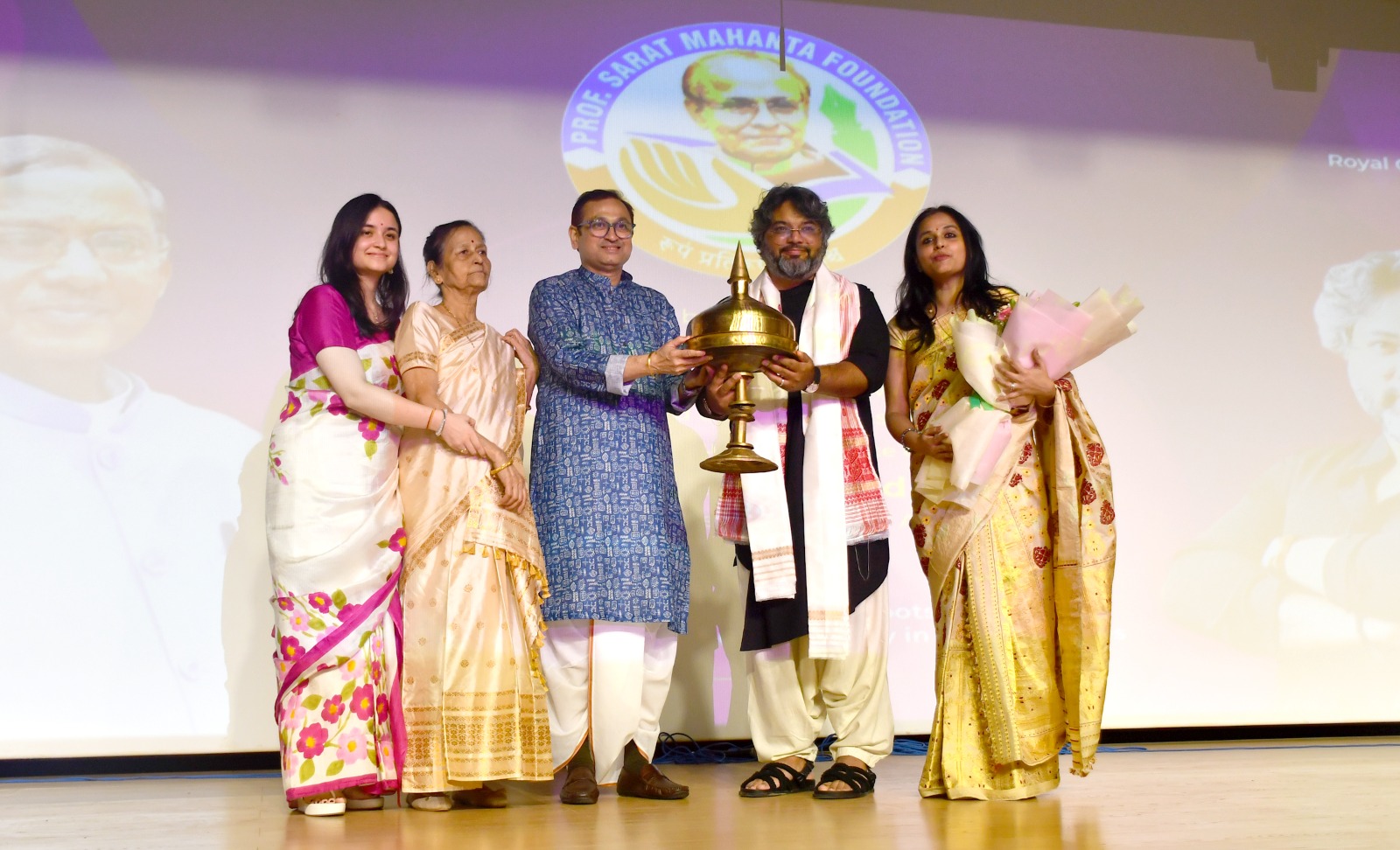
Guwahati, May 1:
Hindu scriptures and ancient Indian texts convey a timeless truth and must not be relegated to the realm of mythology, asserted renowned author, poet, lyricist and motivational speaker Akshat Gupta at the 10th Professor Sarat Mahanta Memorial Lecture held at Royal Global University, Gorchuk, on Thursday evening.
Delivering a powerful and deeply insightful exposition on Hindu dharma, Gupta underlined the need for Indians to reconnect with their ancient roots, culture, and traditions. “The word mythology comes from ‘mithya’, meaning falsehood. When you call Hindu scriptures mythology, you label the Ramayana, Mahabharata, Gita, Upanishads, and Puranas as fiction,” he said.
The bestselling author of The Hidden Hindu trilogy emphasized that such mislabeling alienates younger generations from their heritage. He questioned how devotion could be instilled in children if sacred texts were taught as myths.
Highlighting the colonial distortion of Indian history, Gupta said Hindu scriptures are uniquely singled out as mythology, unlike texts from other religions. He traced this to deliberate colonial efforts to psychologically distance Indians from their dharma and cultural pride. Drawing a vivid parallel, he explained how the term “sir”—originally standing for “slave I remain”—was used to subjugate Africans psychologically after physical domination failed.
Gupta further illustrated how ancient Indian knowledge predated modern discoveries. “Terms like ‘bhugol’ already indicated knowledge of the earth’s roundness and rotation around the sun, centuries before Galileo,” he said. Referring to the depiction of Suryadev’s chariot drawn by seven horses, Gupta explained it symbolizes the seven colours of light, long before the prism theory was known.
He pointed to ancient India’s scientific prowess in astronomy, gravity, communication, and architecture, lamenting how modern education ignores these indigenous achievements. “We have always been rational and scientific, but failed to project our knowledge to the outside world,” Gupta said.
Calling for a revival of Indian pride, Gupta urged changes in early education practices, suggesting alternatives such as teaching “A for Amba,” “B for Bhagwan,” and “C for Culture” to foster cultural belonging among children.
In a bold critique of linguistic imports, Gupta revealed the etymology of terms like ‘aurat’ and ‘madam,’ arguing that they objectify women. He advocated for the revival of respectful native terminologies such as ‘Devi’ to restore dignity to women and reduce gender-based crimes.
Challenging the term “Hinduism,” Gupta said it should be “Hindutva,” as the suffix “-ism” undermines the essence of Sanatan Dharma by equating it with ideologies like communism and terrorism.
Assam Governor Lakshman Prasad Acharya, the Chief Guest, lauded the lecture as a moving tribute to Professor Sarat Mahanta. “We have regained our ‘atmavishwas’ (self-confidence) after centuries of colonial subjugation that had eroded our ‘atmagaurav’ (self-respect),” he noted.
The evening was curated by Dr Upasana Mahanta, Dean at Jindal Global University and daughter of Professor Mahanta, who shared how her father instilled pride in India’s ancient culture and values.
The programme commenced with an invocation by noted singer Zublee Baruah and the ceremonial lighting of the lamp by dignitaries.
Among the distinguished attendees were entrepreneur Riniki Bhuyan Sarma, Assam DGP Harmeet Singh, Chief Minister’s Principal Secretary K.K. Dwivedi, former Eastern Command GOC-in-C Lt. Gen. (Retd.) Rana Pratap Kalita, APSC Chairman Debraj Upadhyay, Advocate General Debajit Lon Saikia, Madhabdev University VC Dr Arupjyoti Chowdhury, former Axom Sahitya Sabha presidents Dr Dhrubajyoti Barua and Surya Hazarika, and renowned actors Pranjal Saikia, Mridula Barua, Moloya Goswami, Zerifa Wahid, and Kapil Borah, among other eminent personalities from various fields.
Comment here